Week 7 Blog
Au Vo
DESMA 9
Dr. Vesna
19 May 2024
Week 7 Blog: Neuroscience
This week’s topic is extremely relevant and fascinating to me as I do research in a biomedical laboratory where I focus on cancer immunotherapy. In addition to my biomedical research, I have to take classes about neuroscience and physiology. Seeing that the topic this week was revolved around this topic made me very excited. At first, it might be a little hard to see the applications of neuroscience in art—I know it took me a while to see the connection. After all, art and biotechnology are on opposing sides. Art typically stimulates the right side of our brain, while biotechnology and other sciences stimulates the left side of the brain. Even at UCLA, we can see this separation between art and science with North Campus housing the humanities and South Campus hosting the sciences.
However, over the past decade, artists and scientists alike have pushed the boundaries between these two disparate fields. They have found ways to incorporate neuroscience and related ideas into art-just like the Octopus Brainstorming exhibit below.

Art, at its core, is an embodiment of how ideas come to fruition. It serves as a medium to convey what someone believes, feels, or envisions, essentially unveiling the processes of the human mind. It is a human concept that is strongly associated with “symbolic and abstract cognition (Zaidel).” This week’s module is particularly interesting to me as a student in biomedical research because it jumps into the inner workings of the human mind and body.
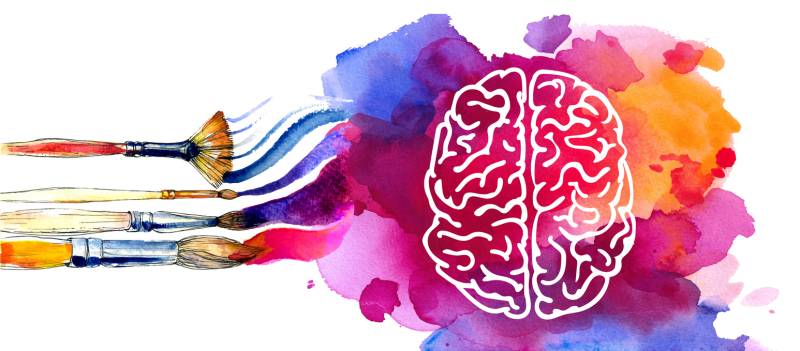
Throughout the week, Professor Vesna taught that the influence between neuroscience and art is bidirectional. The two are intricately connected with one another. Viewing and interpreting art can promote neural plasticity, which involves refining and forming new neural connections (Psychedelic Art: An Exploration of Mind and Creativity). Art can also serve as a method to lower stress and help improve our emotions, moods, and cognitive abilities. This is all driven by the ability of art to help the brain form neural pathways.

The strengthening of the brain and increased connections help viewers and art enjoyers further increase their recognition of deeper meanings within artwork. For example, Schrodinger’s Cat, a thought experiment where a cat in a box can be viewed as both dead and alive due to the uncertainty of its state until it can be seen. This thought experiment shows how observation might affect reality–a concept that artists can utilize to challenge the audience’s brain.
Works Cited
Cleveland Clinic Medical. “Brain: How It Works, Function, Parts & Conditions.” Cleveland
Clinic, my.clevelandclinic.org/health/body/22638-brain. Accessed 18 May 2024.
Issue ten: Enchantment, disenchantment, Reenchantment. CMA Journal - Simon Fraser
University. (n.d.). Accessed 18 May 2024.
“Psychedelic Art: An Exploration of Mind and Creativity.” Mirage News, Mirage News, 30 June
2023, www.miragenews.com/psychedelic-art-an-exploration-of-mind-and-1036398/.
Zaidel, Dahlia W. “Art and brain: insights from neuropsychology, biology and evolution.”
Journal of anatomy vol. 216,2 (2010): 177-83. doi:10.1111/j.1469-7580.2009.01099.x
Comments
Post a Comment